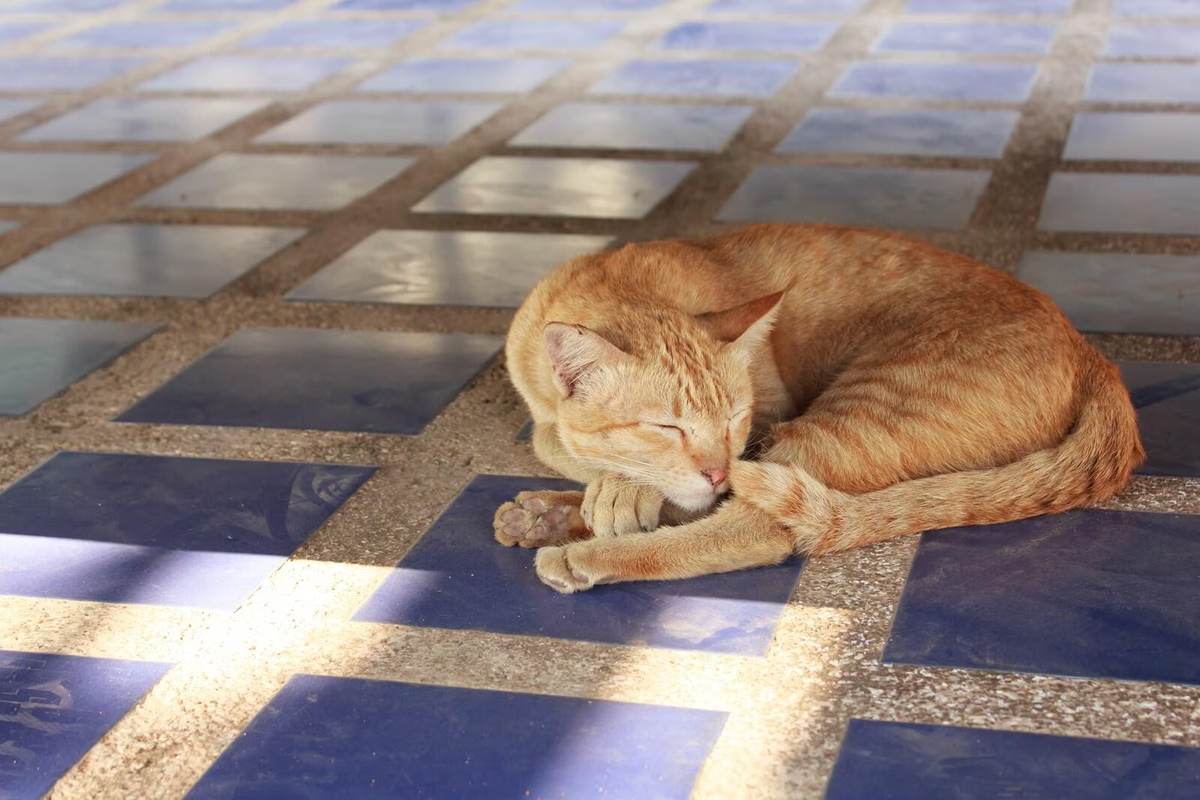
My Cat Stopped Eating During Portland's Smoke Season—And the Vet Bill Taught Me a Hard Lesson
Olivia Brennan
On the third day of the wildfire smoke, I found my cat Milo sitting in his water bowl. Not drinking from it. Sitting in it. His orange fur was soaked, his eyes were half-closed, and he hadn't touched his food in twenty-four hours. I panicked. I called the emergency vet. I spent $847 on bloodwork, IV fluids, and an overnight stay. The diagnosis was heat stress and mild dehydration complicated by poor air quality. The vet told me something that made me feel like the worst cat owner in Portland: "Indoor cats are not immune to heat and smoke. They just have fewer ways to escape it." She was right. And I had been treating Milo like he lived in a climate-controlled bubble while my apartment was slowly turning into a sauna filled with particulate matter from fires burning two hundred miles away.
I've had Milo for six years. He's a rescue. A big, lazy orange tabby who sleeps eighteen hours a day and demands wet food at precisely 6 AM and 6 PM. He's not an outdoor cat. He doesn't go on adventures. He doesn't even like the balcony. So when the wildfire smoke started rolling into Portland in late June, I didn't think much of it. I closed the windows. I turned on the fan. I assumed that because he was indoors, he was safe. I was wrong. The indoor air quality was almost as bad as the outdoor air quality because my apartment has no HVAC system, no air purifier, and windows that leak like a sieve. The smoke seeped in through the gaps around the window frames. It came in under the door from the hallway. It settled into the carpets and the upholstery and the cat bed that Milo spends most of his life in. He was breathing it all day. And he was hot. My apartment hit 87°F on the worst days. For a cat with a fur coat and no ability to sweat, 87°F is not comfortable. It's dangerous.
Cats don't sweat. That's the first thing I learned from the vet. They have sweat glands only in their paw pads. Their primary cooling mechanisms are panting—which cats rarely do unless they're severely stressed—and behavioral adaptations like seeking cool surfaces, reducing activity, and spreading out their body to maximize heat dissipation. Milo had been doing all of these things. He'd been lying on the bathroom tile instead of his bed. He'd been lethargic, which I mistook for "being a cat." He'd been drinking more water, which I noticed but didn't think was abnormal. What I didn't notice was that he was eating less. A lot less. His calorie intake dropped by about 40% over five days. For a cat that was already at the upper end of a healthy weight range, that should have been a red flag. I missed it. Because I was busy dealing with my own heat-related misery and because I assumed that indoor cats were fine.
The vet explained that cats in heat stress reduce their food intake as a survival mechanism. Digestion generates heat. When the ambient temperature is already too high, the body prioritizes cooling over digestion. It's a smart evolutionary adaptation—unless it goes on too long. After about three days of reduced eating, cats start to develop hepatic lipidosis, a dangerous liver condition caused by rapid fat breakdown. Milo was on the edge of that. His bloodwork showed elevated liver enzymes. Not critical, but concerning. Another day or two of not eating and he would have been in real trouble. All because my apartment was too hot and too smoky and I didn't notice the signs.
I bought a HEPA air purifier that same day. $280. I put it in the living room and ran it on high. I bought a cooling mat for Milo. $35. I bought a digital thermometer and started monitoring the temperature in every room. I moved his water bowl to the bathroom, the coolest room in the apartment. I started feeding him smaller, more frequent meals—four times a day instead of two—to reduce the digestive heat load. I mixed extra water into his wet food to increase hydration. And I started brushing him daily because matted fur traps heat and reduces the effectiveness of whatever minimal cooling his body could manage. It was a lot of work. It was expensive. And it was all necessary because the climate had changed and my cat's biology hadn't.
The calorie calculation became a daily obsession. I used to free-feed Milo dry food and give him wet food twice a day. The vet told me to stop free-feeding during heat waves because cats won't eat stale food when they're already not hungry, and uneaten dry food attracts moisture and spoils faster in humid heat. I started measuring every gram. His maintenance requirement is about 280 calories per day for his weight and indoor lifestyle. During the heat wave, he was eating about 160. That deficit, sustained over a week, would have caused significant weight loss and metabolic stress. I had to tempt him with higher-calorie foods. I added a little tuna juice to his wet food. I warmed it slightly—just to room temperature, not hot—to increase the aroma and stimulate his appetite. I fed him in the coolest part of the apartment at the coolest time of day. And I watched him eat, counting every bite, making sure he got at least 220 calories even on the worst days.
The wildfire smoke added another layer of complexity. Cats have sensitive respiratory systems. Their lungs are smaller relative to their body size than human lungs. The particulate matter from wildfire smoke—PM2.5, the tiny particles that penetrate deep into lung tissue—affects them more severely than it affects us. Milo started coughing on the fourth day. Not a hairball cough. A dry, hacking cough that came in fits. The vet said it was likely bronchial irritation from smoke exposure. She prescribed a short course of steroids and told me to keep the air purifier running 24/7. The steroids helped. The cough stopped. But the experience scared me. I realized that my apartment was not a safe haven. It was a trap. The smoke couldn't get out. The heat couldn't get out. And Milo, who had no choice about where he lived, was suffering because of it.
I started talking to other pet owners in my building. The woman in 4C has two Persian cats. She told me she shaved them for the summer. Not a full shave—a lion cut, leaving the fur on the head and legs but removing the body coat. It helped, she said. Their body temperature dropped by about two degrees. They were more active. More playful. But she also said the shave was stressful for the cats and expensive—$120 per cat at the groomer. And not all cats tolerate it. Milo would never tolerate being shaved. He barely tolerates being brushed. So I had to find other solutions. I bought a small desk fan and aimed it at his favorite sleeping spot—not directly on him, but near enough to create air circulation. I put ice cubes in his water. I made "cat popsicles" by freezing wet food in ice cube trays. He loved those. They were messy, but they kept him hydrated and fed simultaneously.
The broader issue is that pet care advice hasn't caught up to the climate. The books say "keep fresh water available." They don't say "check the water temperature every two hours because it gets warm in a 90-degree apartment." The books say "feed a balanced diet." They don't say "reduce meal size and increase frequency during heat waves to prevent digestive heat load." The books say "indoor cats are safe from environmental hazards." They don't say "unless your apartment has no air conditioning and the air quality index is 180." The veterinary industry is starting to address this—there's more research on heat stress in companion animals than there used to be—but the practical advice for pet owners is still woefully inadequate. We're expected to figure it out ourselves, one emergency vet visit at a time.
I'm angry about the $847 bill. Not because I couldn't afford it, but because it was preventable. If I had known the signs of heat stress in cats. If I had known that indoor air quality can be as bad as outdoor air quality in old buildings. If I had known that reduced appetite in a cat during a heat wave is not normal and requires immediate intervention. If any of this information had been readily available, I would have acted sooner. Milo would not have suffered. I would not have spent a sleepless night waiting for bloodwork results. But the information isn't there. Or rather, it's there if you know to look for it. The average pet owner doesn't know to look. They assume their indoor cat is fine. I assumed my indoor cat was fine. And I was wrong.
So here's what I do now. I check the air quality index every morning. If it's above 100, the air purifier runs on high all day. I check the indoor temperature every two hours. If it's above 80°F, I implement cooling measures—fans, ice packs wrapped in towels, cool water changes. I monitor Milo's food intake by weight, not by eye. I know exactly how many grams he should eat and I know when he's under-eating. I watch for lethargy, panting, excessive grooming, and hiding in cool places—all signs of heat stress. And I have an emergency vet fund because I know that climate-related pet health issues are going to keep happening, and they're going to keep being expensive.
Portland's pet owners need to wake up. Our cats and dogs are not safe just because they're indoors. The heat comes in. The smoke comes in. And our pets, who can't open windows or turn on fans or drive themselves to the vet, are depending on us to notice what's happening and act. Milo is fine now. He's back to his normal routine. But I'll never forget finding him in his water bowl, soaked and miserable, because I didn't see what was happening until it was almost too late. The climate is changing. Our pet care needs to change with it. Because the alternative is emergency vet visits, suffering animals, and the kind of guilt that doesn't go away.
How are you keeping your pets cool and safe during the smoke season? Because I'm starting to think we need a Portland Pet Heat Safety Network. And I'm willing to organize it.
The thing that really haunts me is how subtle the signs were. Milo didn't collapse. He didn't start panting dramatically. He didn't meow in distress. He just slowly stopped being himself. He slept more. He moved less. He ate smaller portions. These are all things that could be normal for a cat on a lazy summer day. But they weren't normal for Milo. They were cumulative. They were a signal that his body was struggling, and I missed it because I was struggling too. I was tired from the heat. I was irritable from the smoke. I was distracted by my own discomfort. And I projected my own experience onto him. I thought, "We're both just hot and grumpy. It'll pass when the weather breaks." But Milo's body doesn't work like mine. He can't sweat. He can't open the fridge and get a cold drink. He can't tell me that his liver is starting to break down fat too fast because he hasn't eaten in two days. He depends entirely on my observation, and I failed him.
I started researching feline thermoregulation after the vet visit. Cats have a normal body temperature of 100.5°F to 102.5°F. That's higher than humans. They can tolerate slightly higher ambient temperatures than we can, but only up to a point. The thermoneutral zone for cats—the range where they don't have to expend energy to maintain body temperature—is between 86°F and 97°F. Above 97°F, they start panting. Above 100°F, they risk heat stroke. My apartment was hitting 87°F. That doesn't sound dangerous. But Milo was lying on tile, not moving, breathing slightly faster than normal. He was at the edge of his thermoneutral zone, working hard to stay cool, and I didn't notice because I was also at the edge of my tolerance, working hard to stay cool. We were both suffering, but only one of us could do anything about it.
The wildfire smoke particulates were another invisible threat. PM2.5 particles are 2.5 micrometers or smaller. For comparison, a human hair is about 70 micrometers. These particles are so small that they bypass the respiratory system's natural defenses and penetrate deep into the alveoli—the tiny air sacs where oxygen enters the bloodstream. In humans, this causes inflammation, reduced lung function, and increased cardiovascular risk. In cats, whose respiratory systems are more sensitive and whose body mass is much smaller, the effects are amplified. A cat inhaling PM2.5 at the same concentration as a human is effectively getting a much higher dose per pound of body weight. And cats spend more time near the ground, where particulate matter settles. Milo's favorite sleeping spot was the floor by the window. The same window that was leaking smoke. He was sleeping in the most polluted part of the apartment.
I moved his bed to the bathroom, which has no windows and stays cooler. I put the air purifier in the hallway to create a clean air buffer. I started wet-mopping the floors daily to reduce settled particulates. I bought a second air purifier for the bedroom. I was spending money I didn't have on equipment I shouldn't have needed, but Milo was worth it. He is my family. He is my companion. And I had almost let him get sick because I didn't understand the intersection of climate change and pet care. That intersection is where we live now. It's where all pet owners in the Pacific Northwest live. And we need to get smarter about it, fast.
The vet told me that she's seeing more heat-related cases every summer. Not just in outdoor pets. In indoor pets. In cats like Milo who never go outside. She said the pattern is clear: when the temperature spikes and the air quality drops, the emergency clinic fills up with pets whose owners thought they were safe. Dogs with heat stroke from walking on hot pavement. Cats with respiratory distress from smoke. Rabbits with dehydration because their owners didn't know that rabbits need constant cool water in heat. Birds with feather damage from dry, smoky air. The clinic is a window into how climate change is affecting the animals who share our homes. And the view is not good.
I started a spreadsheet. I know, I know. I'm that person now. But it helps. I track daily indoor temperature, outdoor air quality index, Milo's food intake in grams, his water intake in ounces, his activity level, and any symptoms. I can see the patterns now. On days when the AQI is above 100, he eats less. On days when the indoor temp is above 82°F, he moves less. On days when both are bad, I implement maximum intervention. Extra water. Smaller meals. Cooling mat. Fan. Air purifier on high. And I watch him. I really watch him. Not just a glance to make sure he's breathing. I observe. I notice. I act at the first sign of deviation from his baseline. Because I know now that the first sign is the only warning you get. After that, it's the water bowl. And after that, it's the vet. And after that, it's the bill. And after that, it's the guilt that never quite fades.
