Real Cat Weight Loss Journeys: What Worked, What Didn't, and the Numbers Behind Them
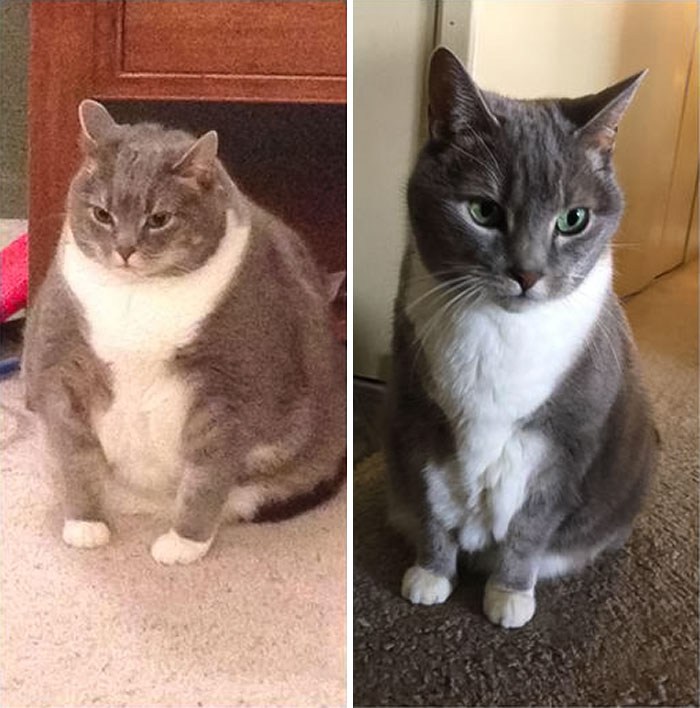
We talk about weight loss in theory. Calorie math. Feeding schedules. BCS charts. But theory doesn't capture the struggle. The guilt. The small victories. The plateaus that feel like failures. I've seen over 200 cats go through weight loss programs. Some succeeded. Some didn't. Here are three real stories — names changed, but numbers real — that show what actually works. Not what should work. What did.
Story 1: Oliver — The Free-Feeder Who Couldn't Stop Begging
Starting weight: 15.2 lbs (BCS 8/9)
Target weight: 11.5 lbs
Age: 5 years
Owner: David, first-time cat parent
Problem: Free-fed kibble, plus "a few" treats whenever Oliver begged. Oliver learned that crying = food. He cried constantly.
What didn't work initially: David tried cutting food by 30% cold turkey. Oliver screamed for hours. David caved after 3 days. "I couldn't take the guilt," he said. What worked: We switched Oliver to 4 small meals per day (6 AM, 10 AM, 4 PM, 9 PM) using an automatic feeder for the two daytime meals. David stopped hand-feeding treats entirely. Instead, he used Oliver's kibble as "treats" — pulling a few pieces from his daily portion. We added 2 tablespoons of canned pumpkin to each meal for bulk.
The numbers: Month 1: 14.5 lbs (-0.7). Month 2: 13.9 lbs (-0.6). Month 3: 13.3 lbs (-0.6) — plateau for 2 weeks, then dropped. Month 6: 12.1 lbs (-3.1 total). Month 9: 11.5 lbs target reached. Oliver now maintains at 11.7 lbs on 3 meals per day. He still cries before meals — but not between them. David told me: "The automatic feeder saved my sanity. I stopped being the bad guy."
Story 2: Gracie — The Senior Cat With Arthritis and Slow Metabolism
Starting weight: 13.8 lbs (BCS 7/9)
Target weight: 11.0 lbs
Age: 12 years
Owner: Margaret, retired, multiple cats
Problem: Gracie had arthritis and hypothyroidism (treated). She was less active but still eating the same amount as younger cats. She also stole food from the other cats.
What didn't work: Reducing calories alone made Gracie lethargic and more painful. Margaret tried separating her during meals, but Gracie would cry and scratch at the door. What worked: We switched Gracie to a senior-specific, high-protein (48% dry matter), moderate-fat food. We added a joint supplement (omega-3s and green-lipped mussel). For meal separation, Margaret bought a microchip-activated feeder for Gracie and for the other cats. Gracie couldn't steal anymore. The other cats couldn't eat her food either. Win-win. We reduced Gracie's calories by only 15% — slower than average — because of her age and thyroid condition.
The numbers: Month 1: 13.4 lbs (-0.4). Month 2: 13.1 lbs (-0.3). Month 3: 12.8 lbs (-0.3). Month 6: 12.1 lbs (-1.7 total). Month 8: 11.4 lbs (-2.4 total). Month 10: 11.0 lbs target reached. Gracie's arthritis improved significantly with the weight loss. She started jumping onto Margaret's bed again — something she hadn't done in 2 years. "The microchip feeder was expensive," Margaret said. "But seeing her on the bed again? Priceless."
Story 3: Pepper — The Pandemic Kitten Who Got Too Comfortable
Starting weight: 9.8 lbs at 8 months (lean) → 13.2 lbs at 2 years (obese)
Target weight: 9.5 lbs
Age: 2 years
Owner: Jenna, works from home
Problem: Pepper was spayed at 6 months. Jenna didn't reduce calories post-spay. She also free-fed dry food and gave Pepper "office snacks" throughout the day — a piece of her lunch here, a bit of cheese there. Pepper gained weight steadily over 18 months.
What didn't work: Jenna tried a crash diet: 50% calorie cut. Pepper lost weight quickly — 1 lb in 2 weeks — but then developed hepatic lipidosis (mild case, caught early). Emergency vet visit cost $800. Jenna was terrified. What worked: We restarted with a slow, safe plan: 20% calorie reduction, wet food only (low-carb, high-protein), 3 scheduled meals per day. No office snacks. Instead, Jenna used a puzzle feeder for Pepper's kibble treats (pulled from her daily portion).
The numbers: Month 1: 12.8 lbs (-0.4). Month 2: 12.4 lbs (-0.4). Month 3: 12.0 lbs (-0.4). Month 4: 11.5 lbs (-0.5). Month 6: 10.8 lbs (-2.4 total). Month 8: 10.2 lbs (-3.0 total). Month 10: 9.7 lbs (-3.5 total). Month 12: 9.5 lbs target reached. Pepper has maintained 9.6-9.8 lbs for 6 months. Jenna said: "The slow approach was frustrating because I wanted quick results. But after the scare with her liver, I learned. Slow and steady is the only way."
What These Stories Teach Us
Looking across all three cases, the success factors were consistent: Measuring tools: Every successful owner used a kitchen scale or microchip feeder. Guessing didn't work. Scheduled meals: Free feeding failed every time. Slow reduction: Crashes caused rebounds or health problems. Owner patience: The most successful owners measured weekly, not daily, and didn't panic at plateaus.
And the common failure mode? Giving up too soon. Most weight loss plans fail in weeks 4-8 — right when the first plateau hits. Cats who stuck with it for 12+ months almost always reached their target.
Success stories aren't about perfection. Every owner in these stories made mistakes. Oliver's owner caved to begging. Gracie's owner delayed getting a microchip feeder. Pepper's owner caused a medical scare. But they kept going. If you've tried and failed before, don't let that stop you. Pick one change — just one — from these stories. A kitchen scale. An automatic feeder. A switch to wet food. Start today. Your cat's success story is waiting to be written. Don't keep them waiting.

Olivia Brennan
Certified Veterinary Nutritionist with 8 years of clinical experience. Creator of Cat Calorie Tool. Based in Portland, Oregon with two rescue cats: Milo and Luna.