Homemade Cat Food: Calculating Calories So You Don't Accidentally Starve Them
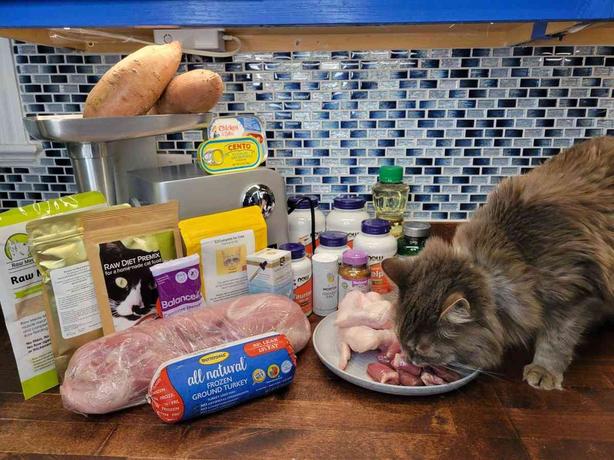
Homemade cat food is hard. Really hard. I'm not saying don't do it. I'm saying if you do it, you need to do it right. And most people don't. In 2024, researchers at UC Davis analyzed 200 homemade cat food recipes from popular websites and books. Over 60% were nutritionally deficient in at least one essential nutrient. Taurine, vitamin E, zinc, and B vitamins were the most common deficiencies. And calorie calculation? Most recipes didn't even include it. Let's fix that. Because homemade food can be excellent — or it can kill your cat. The difference is math.
Step 1: Determine Calorie Needs First
Before you cook anything, calculate how many calories your cat needs per day. Use the calorie calculator. For a 10 lb adult indoor cat, that's roughly 220-240 calories. That's your target. Your homemade recipe must deliver that many calories — no more, no less. If you feed 300 calories of homemade food, your cat will gain weight. If you feed 150, they'll lose muscle. The recipe doesn't matter if the calories are wrong.
Step 2: Calculate Calories in Your Recipe
You need the calorie density of each ingredient. Here's a quick reference per 100 grams: Chicken breast (cooked, no skin): 165 calories. Chicken thigh (cooked, skin removed): 200 calories. Beef (lean ground, cooked): 250 calories. Turkey (cooked ground): 180 calories. Salmon (cooked): 230 calories. Chicken liver: 170 calories. Cooked white rice: 130 calories. Cooked pumpkin (plain): 20 calories. Egg (scrambled, no oil): 150 calories.
Let's say you make a batch with 500g chicken breast, 100g chicken liver, and 200g pumpkin. Total calories = (500g × 1.65) + (100g × 1.7) + (200g × 0.2) = 825 + 170 + 40 = 1,035 calories in the whole batch. If your cat needs 220 calories per day, one batch should last about 4-5 days. But you MUST weigh each portion. Don't guess. A "scoop" of homemade food can vary by 50% in calories depending on whether you hit more meat or more pumpkin.
Step 3: Supplement. Seriously.
Even a "balanced" meat + organ + vegetable recipe will be deficient in taurine, vitamin E, B vitamins, and often calcium/phosphorus balance. Cats require synthetic taurine — cooking destroys natural taurine in meat. You must add a powdered supplement designed for homemade cat food. There are good commercial supplement mixes (a commercial supplement, a commercial supplement, a commercial supplement). Follow their instructions exactly. Do not guess. Do not substitute dog supplements.
A 2023 case report in the Journal of Feline Medicine and Surgery described a cat fed a "natural" homemade diet without supplement for 18 months. The cat developed dilated cardiomyopathy (heart failure) from taurine deficiency. It was reversible with supplementation — but the owners were horrified. They had no idea. The recipe looked healthy. It had chicken, liver, and vegetables. It was missing taurine. And that missing nutrient almost killed their cat.
Step 4: Portion and Store Carefully
Once you have your calorie density per gram, divide the batch into daily portions. Weigh each portion. Freeze extra. Thaw only what you need. Homemade food spoils faster than commercial food. It has no preservatives. Don't leave it out for more than 30 minutes. Refrigerate leftovers immediately. I had a client — I'll call her Susan — who spent hours making beautiful homemade food for her three cats. She was so proud. Then all three developed diarrhea and one stopped eating. The recipe was fine nutritionally — but she'd left the food out all day because she free-fed. Bacteria grew. She switched to scheduled meals with proper refrigeration. The diarrhea stopped within days. The food was good. The handling was bad.
I don't feed homemade to Milo or Luna. Not because I don't believe in it — because I know myself. I don't have time to do it right every week. I'd rather feed a high-quality commercial food that's guaranteed complete than mess up homemade and hurt my cats. Homemade is a commitment. You need a kitchen scale, a reliable recipe from a veterinary nutritionist (not a blog), a supplement, and strict portion control. If you can do all that, great. Many cats thrive on homemade. But if you can't — or if you're not sure — commercial food is fine. Really. Your cat doesn't care where the food came from. They just care that it's consistent and complete. Before you cook anything, run your recipe through a nutrient calculator. Buy a veterinary-approved supplement. Weigh every portion. And if that sounds like too much work, there's no shame in buying a good canned food. Your cat won't judge you. Their liver will thank you. So will your sleep.
Olivia Brennan
Certified Veterinary Nutritionist with 8 years of clinical experience. Creator of Cat Calorie Tool. Based in Portland, Oregon with two rescue cats: Milo and Luna.